

DevOps/SRE Coding Interview Levels: A Systematic Guide

DevOps and Site Reliability Engineering (SRE) interviews assess your software engineering aptitude, practical coding fluency, debugging skills, and architectural thinking. This guide breaks down the seven distinct levels of coding challenges you may encounter.
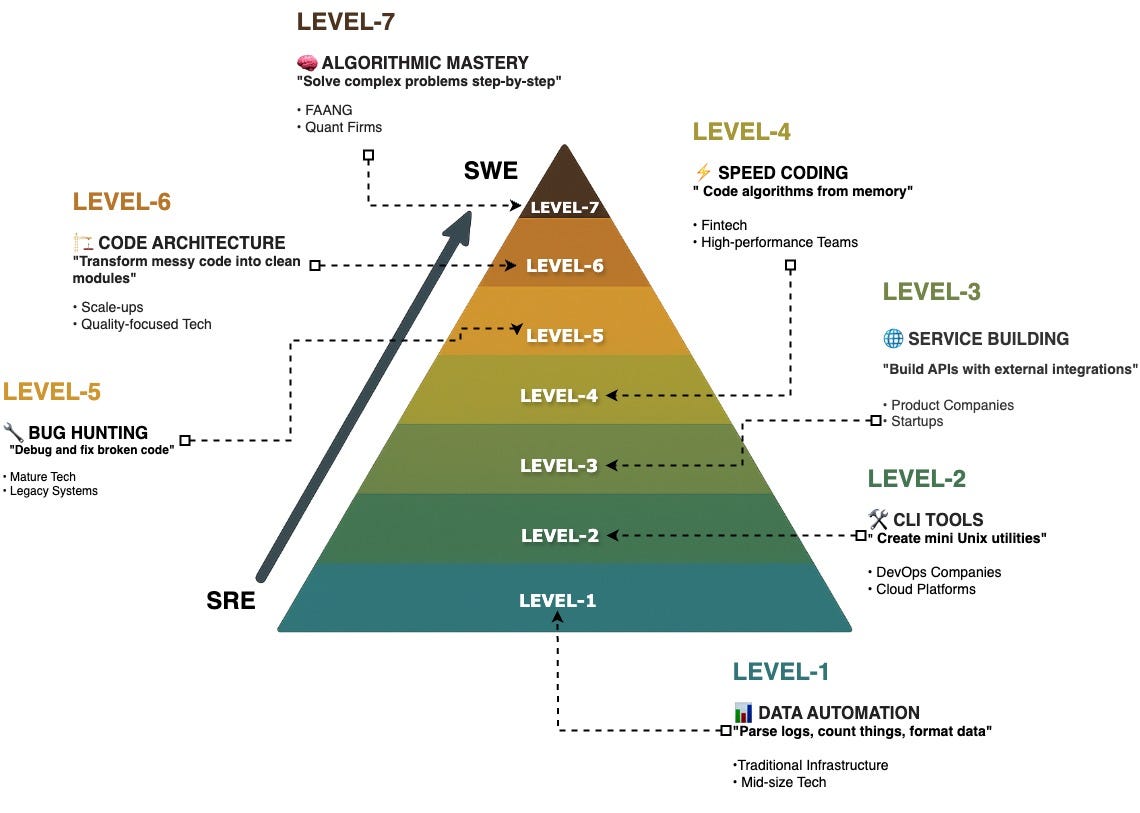
The Seven Levels of DevOps/SRE Coding Challenges
Level 1: Basic Scripting & Automation
One-line summary: Parse logs, count things, and format data - the bread and butter of DevOps automation.
Difficulty: Entry-to mid-level SRE | Company Types: Traditional infrastructure companies, mid-size tech
What it tests: Your ability to handle everyday data processing and automation tasks that mirror real production work.
Sample Problem: Parse an Nginx access log file and extract the top 10 IP addresses by request count. Output should show IP address and count in descending order.
Key Skills:
File I/O and text parsing
Dictionary operations and counting
Data sorting and formatting
Basic statistical operations (percentiles, averages)
Preparation:
Practice with CSV/log parsing in Python/Go
Master dictionary operations and list comprehensions
Work through HackerRank file I/O problems
Build simple ETL scripts for log analysis

Companies: RedHat, VMware, Atlassian, Meta (CSV Dinosaurs), Citadel
Level 2: Tool Integration & CLI Development
One-line summary: Build mini versions of Unix tools like grep, tail, or ps with proper argument handling.
Difficulty: Mid-level SRE | Company Types: DevOps-focused companies, cloud platforms, infrastructure vendors
What it tests: Your ability to build command-line tools that integrate with existing systems and provide good user experience.
Sample Problem: Build a simplified tail -f command that monitors a file for new lines and prints them in real-time. Support -n flag for number of lines to show initially.
Key Skills:
Command-line argument parsing
File system operations and monitoring
Process management and signal handling
Tool design and user experience
Preparation:
Build CLI tools using argparse/cobra libraries
Study existing Unix commands and their interfaces
Practice file watching and real-time processing
Read "Build Your Own X" project tutorials
Companies: Cisco, Uber, Stripe, HashiCorp
Level 3: Service Development & API Integration
One-line summary: Build complete microservices that consume external APIs and apply algorithmic logic under time pressure.
Difficulty: Senior SRE | Company Types: Product companies, API-first startups, platform engineering teams
What it tests: Your ability to build complete services that integrate external APIs with algorithmic logic under time pressure.
Sample Problem: Create a REST service that takes a GitHub username and returns their "coding activity score" by fetching commit data from GitHub API, analyzing commit frequency, and applying a weighted scoring algorithm.
Key Skills:
REST API integration and error handling
JSON parsing and data transformation
Algorithm implementation (graph algorithms, scoring systems)
Service architecture and endpoint design
Preparation:
Practice with public APIs (GitHub, Google Maps, Weather)
Implement graph algorithms (Dijkstra, BFS/DFS)
Build small web services with API integration
Master HTTP client libraries and error handling
Companies: Google, Lyft, Scale.ai, Palantir
Level 4: Language Mastery & Rapid Implementation
One-line summary: Code basic algorithms from memory without documentation - proving your programming fundamentals are solid.
Difficulty: SRE with strong coding background | Company Types: High-performance teams, fintech, competitive tech environments
What it tests: Your coding fluency and ability to implement algorithms quickly without referring to documentation.
Sample Problem: Given a 2D matrix, print all elements in spiral order (clockwise from outside to inside). Must implement in under 30 minutes with clean, bug-free code.
Key Skills:
Matrix and array manipulation patterns
Loop control and boundary management
Quick, accurate implementation
Muscle memory for common algorithms
Preparation:
Daily coding drills on arrays/matrices
Time yourself on implementation problems and use langauge inbuild functions extensively for speed
Practice without IDE assistance or documentation
Master common patterns (two pointers, sliding window, etc)
Companies: Meta, Citadel, Bloomberg, Oracle Cloud
Level 5: Code Review & Bug Resolution
One-line summary: Debug broken code and fix it while explaining what went wrong and why.
Difficulty: Senior SRE/Staff SRE | Company Types: Mature tech companies, companies with large legacy codebases
What it tests: Your ability to quickly identify and fix bugs in existing code while maintaining its intended functionality.
Sample Problem: Given a broken recursive function that should calculate Fibonacci numbers but returns incorrect results, identify the bug, fix it, and then modify it to handle negative inputs gracefully.
Key Skills:
Code reading and comprehension
Systematic debugging approach
Bug pattern recognition (off-by-one, infinite loops, null pointers)
Root cause analysis and explanation
Preparation:
Practice debugging broken code on Exercism.io
Study common bug patterns in recursion and loops
Learn to trace code execution mentally
Debug open source projects to build pattern recognition
Companies: Affirm, Square, Spotify
Level 6: Architecture & Code Standards Leadership
One-line summary: Transform messy but working code into clean, maintainable modules without breaking functionality.
Difficulty: Principal SRE/SRE Manager | Company Types: Scale-up companies, tech companies emphasizing code quality
What it tests: Your ability to transform messy, working code into clean, maintainable, well-structured code without changing functionality.
Sample Problem: Refactor a 150-line monolithic function that processes user data, validates inputs, calls multiple APIs, and formats output. Split into logical functions with clear responsibilities while preserving exact behavior.
Key Skills:
Code smells identification (long functions, nested conditions, duplicated logic)
Function decomposition and single responsibility principle
Naming conventions and code organization
Maintainability over performance optimization
Preparation:
Study "Clean Code" and "Refactoring" principles
Practice refactoring legacy codebases
Learn design patterns and when to apply them

Companies: Netflix, Airbnb, Isomorphic Labs, Cloudflare
Level 7: Expert Problem Solving & Algorithmic Mastery
One-line summary: Solve complex algorithmic challenges by breaking them into subproblems while explaining your thought process clearly.
Difficulty: SWE-level SRE/Staff+ | Company Types: FAANG companies, algorithmic trading firms, companies with SWE-heavy SRE teams
What it tests: Your ability to break down complex problems into subproblems and implement optimal solutions while clearly explaining your thought process.
Sample Problem: Implement the "Trapping Rain Water" algorithm. You must demonstrate problem decomposition: start with brute force, identify subproblems, and build up to the optimal two-array solution. Explain each step.
Key Skills:
Problem decomposition and step-by-step reasoning
Advanced data structures (stacks, heaps, graphs)
Algorithm optimization and complexity analysis
Clear communication of problem-solving approach
Preparation:
Focus on problem-solving process, not memorization
Practice explaining solutions step-by-step
Master fundamental algorithms and data structures
Work through LeetCode medium problems with emphasis on approach

Common Topics: Arrays, strings, stacks/queues, recursion, dynamic programming (quant firms)
Companies: Google (SWE-heavy SRE), Two Sigma, Roblox, Databricks
Strategic Interview Insights
Reality Check: Most DevOps/SRE work involves architecture, debugging, and system design—not daily algorithmic puzzles. However, top tech companies use algorithmic challenges to assess general problem-solving ability.
Success Strategy:
Levels 1-3: Essential for all DevOps/SRE roles
Level 4: Required for fast-paced environments
Level 5: Critical for senior positions
Level 6: Expected for tech leads and architects
Level 7: Primarily for SWE-heavy SRE roles at top tech companies
Company Focus:
Traditional DevOps: Emphasize Levels 1-3, 5-6
Big Tech SRE: Prepare for all levels, especially 4 and 7
Fintech/Quant: Strong focus on mathematical problem-solving (Level 7)
Startups: Practical coding and tool-building (Levels 1-2, 5)